 Ghost Tours Edinburgh Scotland
Greyfriars Kirkyard: History, Graves and the Mackenzie Poltergeist
Greyfriars Kirkyard is one of the most storied burial grounds in Edinburgh, and it sits a short walk from the Royal Mile in the Old Town. This guide covers what the record actually shows, from the friary land of 1561-1562 to the Covenanter's Prison of 1679, the tomb of Bloody Mackenzie and the graves that draw Harry Potter fans. It also explains how to visit, because one whole section of the kirkyard is kept locked. Every figure here comes from official and reputable sources, and the legends are labelled as legends, never as fact. The bookable tours are compared on Edinburgh ghost tours.
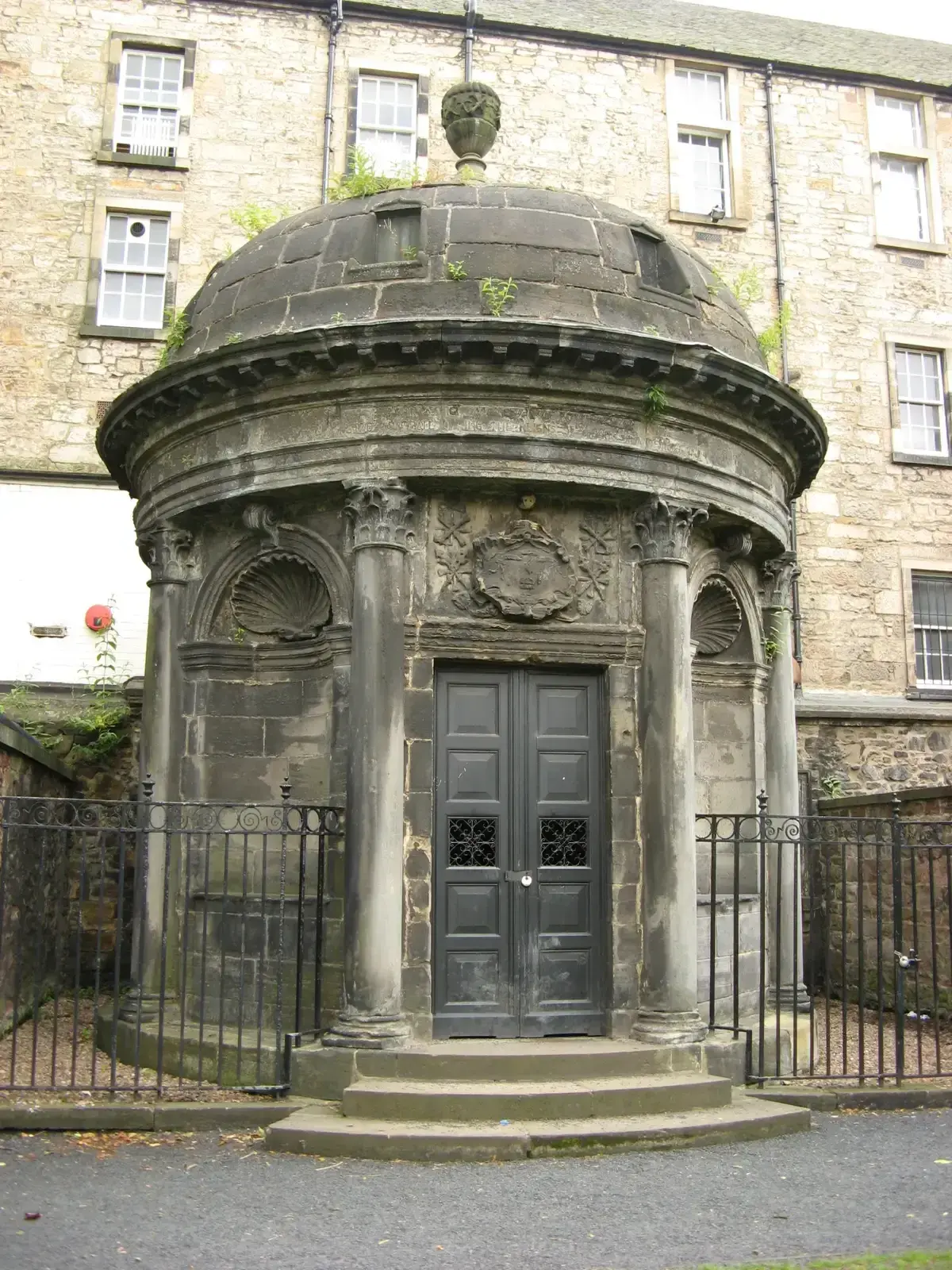
The domed mausoleum of George Mackenzie of Rosehaugh, designed by James Smith in 1691. Photo: Jonathan Oldenbuck, CC BY-SA 3.0, via Wikimedia Commons
Quick answer Greyfriars Kirkyard at a glance
Greyfriars Kirkyard is the Old Town burial ground of Edinburgh, founded in 1561-1562 on land of a dissolved Franciscan friary. It is famous for the National Covenant signed at Greyfriars in 1638, the Covenanter prisoners held there after the Battle of Bothwell Bridge in 1679, the tomb of George Mackenzie tied to the Mackenzie Poltergeist legend, and a grave stone reading Thomas Riddell that fans link to Harry Potter. The kirkyard is a Category A listed site owned by the City of Edinburgh Council.
Key takeaways
- The locked Covenanter's Prison is inside the kirkyard. See who can take you in and read the full story in the Covenanters' Prison section.
- The pick for entering the locked prison on a tour is City of the Dead: The Double Dead Tour at $34.99 for 1 hour 45 minutes with groups capped at 6.
- The kirkyard address is 26A Candlemaker Row, Edinburgh EH1 2QE. Entry is free and no fixed gate hours are printed, so check locally on the day.
- The Skye Terrier who guarded a grave here has his own story, told in Greyfriars Bobby.
Greyfriars Kirkyard: What the Record Shows
Greyfriars Kirkyard carries nearly five centuries of documented history, from a ransacked friary to the signing of the National Covenant. The table below pulls the dated events from the record so you can see the timeline at a glance before the sections that explain each one.
From Friary Land to Burial Ground
The Grey Friars, Franciscan Observants, first came to Scotland in 1447 at the invitation of James I. Between 1453 and 1458 they settled at the corner of the Grassmarket and Candlemaker Row, on ground now covered by the kirk and kirkyard. A mob ransacked the friary on 28 June 1559 during the Reformation, and the friary was dissolved in 1560.
In 1562 Mary Queen of Scots granted the friary grounds to the town council as a burial ground. The move replaced the overcrowded burial ground at St Giles, which was discontinued around 1600. The kirkyard was founded in August 1562 and stayed in use as a burial ground until the mid-Victorian period. Today it is a Category A listed site owned by the City of Edinburgh Council, and it sits at about 55.9467 N, 3.1922 W in the Old Town.
Two low iron cages stand in the kirkyard as mortsafes, devices built to stop body snatchers reaching fresh graves. They survive from the era when resurrection men dug up the recently dead to sell to anatomists. That trade, and the men who took it to murder, is a story of its own, told in Burke and Hare, who killed 16 people in 1827 and 1828 to supply anatomist Robert Knox.
The kirkyard walls carry some of the oldest carved work. Wall monuments from the early 17th century line the east and west walls, and the John Byres monument dates from 1629 and was made by the royal master mason William Wallace. In the 1840s the pioneering photographers David Octavius Hill and Robert Adamson used the kirkyard for portrait sittings, including a picture titled The Artist and the Gravedigger.
| Year | What happened |
|---|---|
| 1447 | Franciscan Observants first come to Scotland at the invitation of James I |
| 1453-1458 | The Grey Friars settle at the corner of the Grassmarket and Candlemaker Row |
| 28 June 1559 | A mob ransacks the friary |
| 1560 | The friary is dissolved at the Reformation |
| August 1562 | Mary Queen of Scots grants the grounds to the town council as a burial ground, replacing the ground at St Giles |
| 1602 | Building of the kirk begins under master mason Clement Russell |
| 1620 | Greyfriars Kirk is completed and first used for worship on Christmas Day |
| 1638 | The National Covenant is signed at Greyfriars |
| 1679 | About 400 Covenanter prisoners are held in a makeshift enclosure in the kirkyard |
| around 1700 | The prison field is enclosed with vaulted tombs and becomes known as the Covenanters' Prison |
| 7 May 1718 | A gunpowder explosion at about 1:45am destroys the kirk tower |
| 19 January 1845 | A fire from an overheated boiler flue damages the kirk |
The Kirk and the National Covenant
The town council decided in 1601 to build a church on the new burial ground, and work began in 1602. The kirk was completed in 1620 and first used for worship on Christmas Day 1620, though its first funeral, that of Bishop William Couper, had taken place on 18 February 1619. The building measures 162 feet long and 72 feet wide and is Category A listed under reference LB27018.
Its place in Scottish history was fixed in 1638, when the National Covenant was read from the pulpit of Greyfriars and signed at Greyfriars by nobility and gentry on 28 February 1638. The Covenant pledged defence of Presbyterian church government against the king's reforms, and the people who upheld it became known as Covenanters. The kirk still displays an original copy of the National Covenant of 1638.
The building has been through fire and explosion. In 1706 the town council began storing gunpowder in the west tower, and the stores went up at about 1:45am on 7 May 1718, destroying the tower and damaging the west end. The kirk was repaired and reopened in 1722 as two congregations, Old Greyfriars and New Greyfriars. The fire of 19 January 1845 started from an overheated boiler flue. Architect David Cousin rebuilt Old Greyfriars in 1856 and 1857, and the 1857 windows were the first coloured glass in a Church of Scotland parish church since the Reformation. Minister Robert Lee installed a harmonium in 1863, the first organ in a Church of Scotland building.
The two congregations united in 1929, and Henry Kerr restored the kirk between 1932 and 1938, adding a barrel ceiling of California redwood. The 1989 organ by Peter Collins has nearly 3,400 pipes, and its case carries a carved Greyfriars Bobby among the details. Cromwell's cavalry had stabled in the kirk as barracks between 1650 and 1653, long before any of that. Today the kirk holds Sunday services at 11am, a Thursday prayer service at 1:10pm and a Gaelic service at 12:30pm on Sundays, and entry is free with donations encouraged. The kirk address is Greyfriars Place, Edinburgh EH1 2QQ, a step from the kirkyard gate on Candlemaker Row.
Sources: Greyfriars Kirkyard, Greyfriars Kirk, Greyfriars Kirk visit page, Cockburn Association
The Covenanter's Prison and Bloody Mackenzie
This corner of the kirkyard holds the story that makes it famous among ghost hunters. The documented history is harsh enough on its own, and the ghost story that grew on top of it is a late-1990s legend told on tours.
Bothwell Bridge and the Prisoners
After the Battle of Bothwell Bridge in 1679, about 1,200 defeated Covenanter prisoners were brought to Edinburgh. About 400 of them were held in a makeshift open enclosure in the south of Greyfriars Kirkyard, walled on two sides by the Flodden Wall and on the west by the wall of George Heriot's School. The men had fought for the Covenant signed at Greyfriars in 1638, and now they were imprisoned in the ground where it had been signed.
The field did not stay a prison for long. The City Bedlam was built over most of it around 1690, and the remaining strip became a burial ground around 1700, enclosed with vaulted tombs. Those vaults date from the 17th and 18th centuries and were never used as cells, whatever tour tales suggest. The enclosed strip is the section now called the Covenanters' Prison.
The kirkyard also holds graves of Covenanters executed elsewhere in the city. The Martyrs' Monument records executed Covenanters including James Guthrie, James Renwick and the Marquis of Argyll. Hugh Mackail, tortured with the boot and hanged in 1666, is buried here, as is John Nisbet, hanged in the Grassmarket in 1685. The Grassmarket gallows took more than 100 Covenanters between 1661 and 1688, so the kirkyard monuments record only part of the killing of that era.
- About 1,200 prisoners came to Edinburgh after Bothwell Bridge in 1679
- About 400 were held in the makeshift enclosure at Greyfriars
- The enclosure was enclosed with vaulted tombs around 1700
- The section was sealed around 1990 and opens only by arrangement or on guided tours
Who Was Bloody Mackenzie?
Sir George Mackenzie of Rosehaugh was born in Dundee in 1636 or possibly 1638 and died on 8 May 1691. He was admitted to the Faculty of Advocates in 1659, served as justice-depute from 1661 to 1663 and took part in witch trials in those years. He became Lord Advocate in 1677, the office in which he persecuted the Covenanters and earned the nickname Bluidy Mackenzie, later spelled Bloody Mackenzie. More than 100 Covenanters were hanged in the Grassmarket between 1661 and 1688 during the years of persecution he led.
He was more than a prosecutor. He defended the Marquis of Argyll at his 1661 trial, wrote Aretina in 1660, described as possibly the first Scottish novel, and wrote Laws and Customes of Scotland in Matters Criminal in 1678, the first Scottish criminal law textbook. He later argued that witches were fewer than commonly believed and that confessions came from torture. He founded the Advocates Library, with his inaugural oration dated 15 March 1689, and became Dean of the Faculty of Advocates in 1682. He resigned as Lord Advocate in 1686, resumed the office in 1688 and retired to Oxford at the Glorious Revolution.
The nickname stuck in literature. Walter Scott used the epithet Bluidy Mackenzie in The Heart of Midlothian of 1818, and John Galt made Mackenzie a character in the 1823 novel Ringan Gilhaize. Sir George Lockhart, a murder victim of 1689, was buried in Mackenzie's tomb, so the mausoleum holds more than its builder.
The Black Mausoleum and the Mackenzie Poltergeist
Mackenzie's tomb, known as the Black Mausoleum or the Mackenzie Poltergeist mausoleum, is an Italianate domed structure designed by the architect James Smith and modelled on Bramante's Tempietto. It stands in the kirkyard within sight of the Covenanters' Prison, and it is the structure tied to the Mackenzie Poltergeist stories.
The legend dates to the late 1990s. The story says a homeless man broke into the Black Mausoleum in the late 1990s and fell through the floor into a pit of plague bodies. After that, visitors began reporting bruises, scratches and cold spots near the mausoleum. None of it is proven. The accounts rest on tour and press reporting, and this site tells the tale as a legend, never as a documented haunting.
Wikipedia reports a separate break-in in 2003, when two teenage boys aged 17 and 15 entered the Black Mausoleum through a ventilation slot and broke open coffins in the lower vault. One of them stole a skull, and the ventilation slot was sealed afterwards. The two boys narrowly escaped prison on a charge of violating sepulchres. Today the Black Mausoleum can be visited only on night tours, and the Covenanters' Prison beside it is kept locked and opened only for guided groups.
The operator most associated with that access is City of the Dead Tours, which says it has after-hours access to the Covenanter's Prison and designed its tours around the Mackenzie Poltergeist. The company says Lonely Planet named it Edinburgh's best ghost tour, its own claim. Its City of the Dead: The Double Dead Tour costs $34.99, runs 1 hour 45 minutes, takes groups of up to 6 and joins the South Bridge Vaults to the locked prison in one booking. The guide meets you at the tree on the pavement at the side of St Giles' Cathedral on the Royal Mile, not the front of the church, and the minimum age is 12. If you want kirkyard and vaults in one walk at a larger group size, Edinburgh Haunted Underground Vaults and Graveyard Tour by Auld Reekie Tours costs $34 for 1.5 hours and covers the Bobby legend, the mausoleums and the South Bridge Vaults, though it does not enter the locked prison.
Sources: Greyfriars Kirkyard, George Mackenzie of Rosehaugh, The Scotsman on the Mackenzie Poltergeist, City of the Dead Tours
The Truth Behind Edinburgh's Haunted Graveyard: A Full Tour of Greyfriars Kirk
A walk around Greyfriars Kirk and its kirkyard, grave by grave. Third-party video by The Museum Guide. This site did not shoot it and has no relationship with the creator.
The Mackenzie Poltergeist
The most famous ghost story in Edinburgh attaches to the Black Mausoleum, the domed tomb of Sir George Mackenzie in Greyfriars Kirkyard. It is a legend from the late 1990s, not a documented haunting.
The Break-In Story
The story says a homeless man broke into the Black Mausoleum in the late 1990s and fell through the floor into a pit of plague bodies. There is no official record of the event. From that story grew the Mackenzie Poltergeist legend, which places the unrest at the tomb of the man who persecuted the Covenanters held in the kirkyard after 1679.
The ghost in the legend is Mackenzie himself, Bluidy Mackenzie, the Lord Advocate who earned his nickname persecuting the Covenanters. Historians know him as a serious figure. He lived from 1636 to 8 May 1691, became Lord Advocate in 1677, wrote the first Scottish criminal law textbook in 1678 and founded the Advocates Library with his inaugural oration of 15 March 1689. His tomb is an Italianate domed structure designed by the architect James Smith and modelled on Bramante's Tempietto. The legend sits on top of all that, and should be told as a legend.
The Reports, and What They Are Worth
Visitors have reported bruises, scratches and cold spots near the mausoleum. None of it is proven. These accounts come from tour operators and press coverage, not from any independent investigation, so this page reports them as claims rather than facts.
Wikipedia reports a second break-in. In 2003 two teenage boys, aged 17 and 15, entered the Black Mausoleum through a ventilation slot and broke open coffins in the lower vault. One of them stole a skull, the slot was sealed afterwards, and the pair narrowly escaped prison on a charge of violating sepulchres. The hauntings have no such record.
If you want to stand at the tomb and hear the story told in full, the Black Mausoleum can be visited only on night tours. The City of the Dead: The Double Dead Tour at $34.99 goes into the locked Covenanter's Prison beside the mausoleum.
Why the Prison Is Locked
The Covenanters' Prison section was sealed around 1990 and is kept locked, opened only for guided groups. The City of Edinburgh Council owns Greyfriars Kirkyard and says it locks the area to protect the graves. That is the council's stated reason, and vandalism at the Black Mausoleum is exactly the kind of damage the lock is meant to prevent.
There are two ways in without paying for a ghost tour. You can ask the council bereavement team for access to the locked area, and the Friends of Greyfriars Kirkyard run free tours for community groups and hold special open days that need no booking. The council's Parks and Greenspaces team has also made a 360-degree virtual tour that includes the locked Covenanters' Prison, so you can see the section free from home.
Sources: Wikipedia, The Scotsman, Edinburgh News
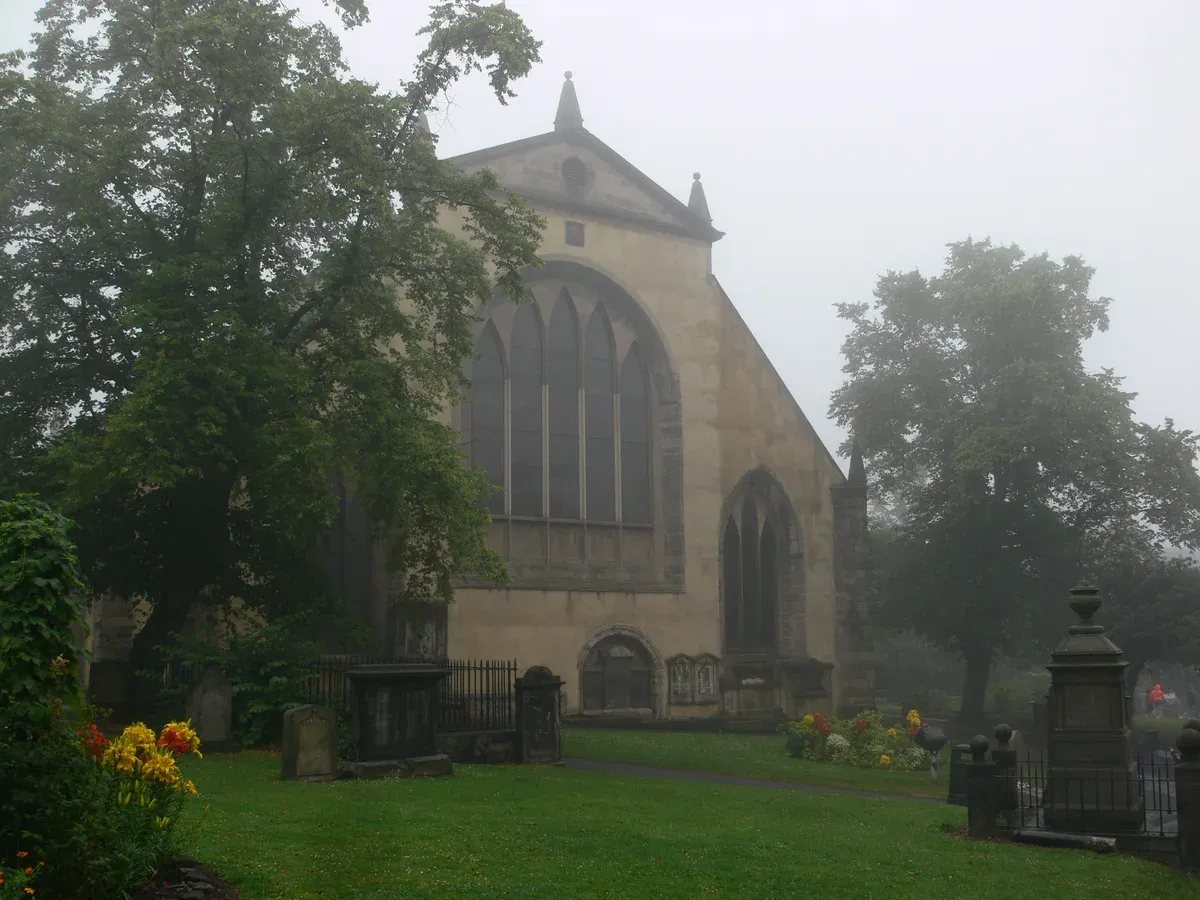
Greyfriars Kirk stands at the heart of the kirkyard on Candlemaker Row. Photo: Remi Mathis, CC BY-SA 3.0, via Wikimedia Commons
Graves to Find in Greyfriars Kirkyard
The kirkyard holds hundreds of notable burials, and a handful of them draw most of the visitors. The table gathers the graves worth seeking out, with who lies there and what to know before you go.
The Famous Burials
The figures and notes below come from the standard references on the kirkyard, including its Wikipedia entry and the Edinburgh News. Roughly 40 notable burials on that list lie in the sealed south-west section, so you cannot reach all of them by day. Geologist James Hutton and physician Joseph Black both lie in the Covenanters' Prison area, which means a guided group or an open day to see their resting places. Thomas Riddell died in 1806 aged 72, and the ground around his stone has suffered significant erosion from the number of Harry Potter fans who visit.
Architects are well represented. James Craig, who designed the New Town, is buried here, along with William Adam and his son John Adam and the master mason John Mylne. Encyclopaedia Britannica creator William Smellie, historian William Robertson and poet William McGonagall, who died on 29 September 1902, are all here too. The John Byres monument of 1629, made by the royal master mason William Wallace, survives on the walls, and the kirkyard has wall monuments from the early 17th century.
| Grave | Who they were | Note |
|---|---|---|
| Thomas Riddell | Died in 1806 aged 72 | May have inspired J. K. Rowling's Tom Riddle, though she has not confirmed it. Visitor traffic has eroded the ground around the stone |
| James Hutton | Geologist, 1726 to 1797 | Lies in the south-west Covenanters' Prison section, so only reachable on a guided entry or open day |
| Joseph Black | Physician, 1728 to 1799 | Also in the Covenanters' Prison section, behind the lock |
| Allan Ramsay | Poet, 1686 to 1758 | Buried at Greyfriars |
| Colin MacLaurin | Mathematician | One of the hundreds of notable burials recorded in the kirkyard |
| John Gray | Edinburgh City Police nightwatchman who died of tuberculosis on 15 February 1858 | His grave is the one the Greyfriars Bobby story attaches to. The story says his dog guarded it for 14 years, which historians question |
Mortsafes and Body Snatching
Two low iron cages stand in the kirkyard. They are mortsafes, iron or iron and stone devices padlocked over coffins to stop the resurrection men who dug up fresh graves to sell bodies to anatomy schools. A mortsafe stayed on a grave for about six weeks, until the body was too decayed to be of use, and was then reused. Communities also built watch-houses to shelter grave watchers, and Edinburgh was the city where the trade turned murderous.
Between 1827 and 1828 William Burke and William Hare killed 16 people in the West Port and sold the bodies to the anatomist Robert Knox, who paid around 8 to 10 pounds per body. The mortsafe you can see at Greyfriars is the physical evidence of the fear that ran before them. The full story of the killings, the trial and the anatomy trade is told on the Burke and Hare page.
Sources: Wikipedia, Edinburgh News, Mortsafe
How to Visit Greyfriars Kirkyard
Greyfriars Kirkyard is free to enter and sits right off the Grassmarket end of the Old Town. Only one corner of it is locked, and that is the part the ghost tours sell.
Getting There and Opening Times
The kirkyard address is 26A Candlemaker Row, Edinburgh EH1 2QE, on the site of a Franciscan friary dissolved in 1560. The land passed to Edinburgh in 1562 and was used as a burial ground until the mid-Victorian period. Entry to the kirkyard is free by day. Gate hours are not confirmed, so check locally when you arrive rather than planning around a fixed time.
Greyfriars Kirk itself is at Greyfriars Place, Edinburgh EH1 2QQ, completed in 1620 and first used for worship on Christmas Day that year. Entry to the kirk is free, although donations are encouraged, and there is a museum and volunteer Welcomers on site. The kirk holds Sunday services at 11am, plus a Thursday prayer service at 1:10pm and a Gaelic service at 12:30pm on Sundays. Inside you can see an original copy of the National Covenant of 1638 and a portrait of Greyfriars Bobby from 1867. Self-guided information boards in the kirkyard come in several languages.
The Locked Covenanter's Prison and How to Get In
The open part of the kirkyard costs nothing and holds most of what people come for: the Riddell grave, the mortsafes, the Martyrs' Monument, the walls with their early 17th-century monuments. The Covenanters' Prison is different. It was sealed around 1990 and is kept locked to protect the graves, by the council that owns the site.
Two ways in. The paid way is a ghost tour whose operator says it holds the key. The City of the Dead: The Double Dead Tour at $34.99 takes groups of up to 6 into the Covenanter's Prison and the South Bridge Vaults over 1 hour 45 minutes. The free ways are an arrangement with the council bereavement team, or the Friends of Greyfriars Kirkyard open days, which need no booking. If neither falls on your dates, the council's 360-degree virtual tour covers the locked section.
For the open part of the kirkyard with a guide, the Auld Reekie vaults and graveyard tour costs $34 and runs 1.5 hours, combining Greyfriars Kirkyard with the Edinburgh Vaults under South Bridge.
Sources: Cockburn Association, Greyfriars Kirk, Edinburgh News
Ghost Tours That Go Into Greyfriars
Three bookable tours in the comparison route through Greyfriars Kirkyard, and one more passes the kirk. Only one of the three gets you inside the locked Covenanter's Prison, and the table shows which part of the kirkyard each tour covers and what it costs.
Comparing the Routes
The figures below come from the booking platform listings. Note the honest differences. The City of the Dead Double Dead Tour at $34.99 is the only one of the three that enters the Covenanter's Prison, where the Black Mausoleum stands.
The Auld Reekie and City of Edinburgh tours cover the open kirkyard, and both add the underground vaults for a combined ticket. The Ghost Bus passes Greyfriars Kirk on its route but stops at none of it. Starting times are not listed in advance, so check availability for the day you want.
| Tour | Price | Length | Which part |
|---|---|---|---|
| City of the Dead: The Double Dead Tour | $34.99 | 1 hour 45 minutes | The Covenanter's Prison and the South Bridge Vaults, groups of up to 6 |
| Edinburgh Haunted Underground Vaults and Graveyard Tour | $34 | 1.5 hours | The open kirkyard, the Bobby legend and the notable graves, then the South Bridge Vaults |
| Edinburgh Evening Underground Ghost Tour | $25 | 75 minutes | A stop at Greyfriars Kirkyard on the way to the Edinburgh Vaults |
Which One Fits
If the Mackenzie Poltergeist story is the reason for your visit, the Double Dead Tour is the one that stands you inside the locked prison at the tomb. At $34.99 it is also the dearest of the three, and groups are capped at 6 with a minimum age of 12. If you want the kirkyard and the vaults in one evening at the lowest price, the $25 City of Edinburgh option covers both in 75 minutes, though children under 7 are not suitable.
The Auld Reekie tour at $34 splits 1.5 hours between the graveyard and the vaults, suits ages 12 and over, and carries the pick badge in the comparison.
Sources: City of the Dead Tours, Auld Reekie Tours
Greyfriars Kirkyard Questions
What is the oldest grave in Greyfriars Kirkyard?
The oldest specific grave is not named in the sources used for this page. What is documented is burial from 1562 and wall monuments from the early 17th century, including the John Byres monument of 1629 by the royal master mason William Wallace. A guided graveyard tour is the easiest way to date the oldest stones you can still read.
Who is a famous Scottish dog?
Greyfriars Bobby, the Skye Terrier who is said to have guarded John Gray's grave in this kirkyard for 14 years until his death on 14 January 1872. Historians doubt parts of the story, but the bronze statue from 1873 stands on Candlemaker Row at the kirkyard gate. The Greyfriars Bobby page takes the story apart.
How can I find a grave in Greyfriars Kirkyard?
Start with the self-guided information boards in the kirkyard, which come in several languages, and the free entry by day from 26A Candlemaker Row. The Friends of Greyfriars Kirkyard run tours and can help, and the council bereavement team handles access to the locked Covenanter's Prison section where around 40 notable burials lie.
What is a Scottish kirkyard?
A kirkyard is the burial ground that surrounds a Scottish kirk, the Scots word for a church. Greyfriars Kirkyard was founded in 1562 on the grounds of a dissolved Franciscan friary, and the Double Dead Tour at $34.99 is the way into its most famous locked corner.
Is the Greyfriars Kirkyard Harry Potter grave real?
The grave of Thomas Riddell, who died in 1806 aged 72, is real and stands in the kirkyard. It may have inspired J. K. Rowling's character Tom Riddle, though she has not confirmed it. So many fans seek the stone that the ground around it has suffered significant erosion, so visit it respectfully.
Is the Mackenzie Poltergeist real?
There is no evidence that it is. The legend says a homeless man broke into the Black Mausoleum in the late 1990s and that visitors have since reported bruises, scratches and cold spots, and none of it is proven. You can hear the story told on the Double Dead Tour, which goes into the locked prison beside the mausoleum.