 Ghost Tours Edinburgh Scotland
Greyfriars Bobby: the Story, the Statue and the Grave
Greyfriars Bobby is Edinburgh's best known dog, and his story sits a short walk off the Royal Mile at Greyfriars Kirkyard. This page covers the tale of the Skye Terrier who is said to have guarded his owner's grave for 14 years, the bronze statue on Candlemaker Row, the headstone in the kirkyard and the collar in the Museum of Edinburgh. It also covers the doubts that historians have raised, and the Edinburgh ghost tours that include the Bobby legend on their route. The statue, the grave and the pub are all free to see on foot. If you want the kirkyard as a whole, its Covenanters' Prison and the Mackenzie Poltergeist stories, the separate Greyfriars Kirkyard guide handles that in depth.
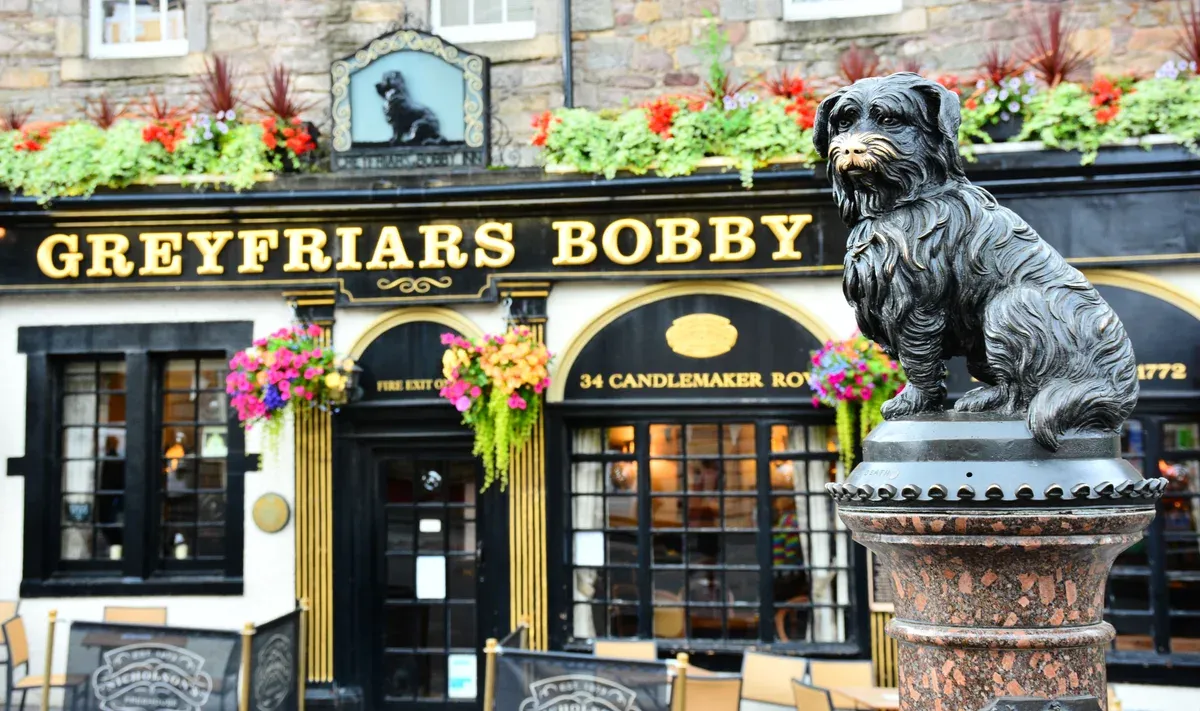
The Skye terrier statue was erected in 1873 beside the Greyfriars Bobby pub. Photo: Mike McBey, CC BY 2.0, via Wikimedia Commons
Quick answer Who was Greyfriars Bobby
Greyfriars Bobby was a Skye Terrier in Edinburgh who, by the story told, guarded the grave of his owner John Gray in Greyfriars Kirkyard for 14 years until his death on 14 January 1872. The bronze statue of Bobby stands opposite the kirkyard gate at the junction of George IV Bridge and Candlemaker Row and was put up in 1873. The grave, the statue and the pub named after him are all free to see within a few minutes' walk of each other.
Key takeaways
- Read the full Greyfriars Bobby story, from John Gray's death in 1858 to Bobby's in 1872.
- Find out was Greyfriars Bobby real, what the record shows and why historian Jan Bondeson doubts the vigil.
- Locate the statue, the grave and the collar, and the nose-rubbing custom that no source backs.
- See which ghost tours tell the Bobby story, from $25 to $34.99, and compare lengths and meeting points.
The Story of Greyfriars Bobby
The tale is short and simple, which is part of why it has lasted. A man dies, his dog will not leave the grave, and the city takes the dog to its heart.
The Tale at a Glance
Greyfriars Bobby was born around 1855 or 1856 and died on 14 January 1872. His owner, John Gray, worked as a nightwatchman for the Edinburgh City Police and died of tuberculosis on 15 February 1858. After Gray's burial in Greyfriars Kirkyard, the story says Bobby took up a post at the graveside and stayed there through every season for 14 years until his own death. The dates in the table below come from the documented record of the story as it is usually told.
The Lord Provost stepped in on Bobby's behalf in 1867, which is the one part of the tale backed by a surviving object. The collar from that year is in a city museum and is covered in the places section.
| Year | What happened |
|---|---|
| About 1855-1856 | Bobby is born, most accounts give Skye Terrier as the breed |
| 15 February 1858 | John Gray, an Edinburgh City Police nightwatchman, dies of tuberculosis and is buried in Greyfriars Kirkyard |
| 1858-1872 | The story says Bobby guards Gray's grave for 14 years |
| 1867 | Lord Provost Sir William Chambers gives Bobby a collar and pays his dog licence, keeping him from being treated as a stray |
| 1872 | The statue is commissioned from sculptor William Brodie |
| 14 January 1872 | Bobby dies, and his headstone later records him as aged 16 years |
| 1873 | The bronze statue is erected on a drinking fountain paid for by Baroness Burdett-Coutts |
| 1981 | Bobby's headstone in the kirkyard is unveiled by the Duke of Gloucester on 13 May |
| 2021 | A 150th anniversary memorial for Bobby is placed near the kirk's east wall |
John Gray, the Nightwatchman
John Gray was not a farmer or a shepherd in the original telling. He was a member of the Edinburgh City Police working as a nightwatchman, and he died of tuberculosis on 15 February 1858. The fictional versions came later and changed him. Henry T. Hutton published an account of the story in 1902, and Eleanor Atkinson's 1912 novel turned Gray into a shepherd called Auld Jock, a change that stuck in popular memory even though it does not match the record.
Gray was buried in Greyfriars Kirkyard, the burial ground that had served the Old Town since 1562. His grave sits on the eastern path about 30 metres north of the entrance, which makes it one of the easiest graves of note to find in the yard. In 2018 vandals toppled Gray's headstone, and it has since been restored. The kirkyard holds hundreds of notable burials besides Gray, from geologist James Hutton to poet Allan Ramsay, and a full walk through them belongs to the Greyfriars Kirkyard guide.
- John Gray: Edinburgh City Police nightwatchman
- Died of tuberculosis on 15 February 1858
- Buried in Greyfriars Kirkyard, grave on the eastern path about 30 metres north of the entrance
The 14-Year Vigil
The heart of the story is the vigil itself. The tale says Bobby guarded Gray's grave for 14 years until his death on 14 January 1872. His headstone, erected by the Dog Aid Society and unveiled by the Duke of Gloucester on 13 May 1981, reads simply: Died 14 January 1872, Aged 16 years.
Some parts of the story are better documented than the vigil itself. In 1867 Lord Provost Sir William Chambers paid Bobby's dog licence. That 1867 gift is the licence that kept Bobby from being treated as a stray, and it exists today as a physical collar. After Bobby died, a necropsy by Professor Thomas Walley found cancer of the jaw. What no document proves is that the same dog sat by the grave for the full 14 years, and that is where the historians' doubts begin.
Bobby is said to be buried just inside the kirkyard gate near John Gray's grave, so the dog and his owner remain close in death as the story demands.
Sources: Greyfriars Bobby, Greyfriars Kirkyard
Was Greyfriars Bobby Real?
Yes and no. A dog called Bobby existed, a collar exists and the statue exists. The 14-year vigil is the part historians question.
What the Record Supports
Several physical facts are not in doubt. Bobby died on 14 January 1872, and the necropsy by Professor Thomas Walley recorded cancer of the jaw, which means a real dog's body was examined. Lord Provost Sir William Chambers paid Bobby's dog licence in 1867, and that collar survives in the Museum of Edinburgh. The bronze statue was commissioned in 1872 from the sculptor William Brodie and erected in 1873, which means the city was honouring a dog people remembered. A 150th anniversary memorial was placed near the kirk's east wall in 2021.
So was Greyfriars Bobby real? A real dog named Bobby almost certainly lived around Greyfriars Kirkyard in the 1860s and was famous enough locally to earn a licence from the Lord Provost. The claim that sits on much thinner ground is the one about duration and devotion: that the dog spent 14 unbroken years at the graveside.
The Breed Dispute
Even the dog's breed is argued over. The breed is usually given as a Skye Terrier, and the 1961 Walt Disney film used a Skye Terrier on screen. But some say Dandie Dinmont, and the point is disputed.
In 2022 Mike Macbeth argued that a Dandie Dinmont Terrier is more likely than a Skye Terrier, pointing to the dog's appearance. No contemporary evidence settles the question, so honest accounts say Skye Terrier as the traditional answer while noting the challenge. The statue itself, made by William Brodie, shows a small long-haired terrier and cannot settle it either.
Bondeson's Stray Theory
Historian Jan Bondeson has questioned the story and suggested Bobby was a stray fed by visitors. In 2011 Bondeson argued further that the original Bobby may have died in 1867 and been replaced by a younger dog. He counted more than 60 documented accounts of graveyard dogs in 19th-century Europe, so the pattern of a dog living in a burial ground was not unique to Edinburgh. The tale was popularised by John Traill, the coffee house owner who told it, and Traill did not own his business until four years after Gray died, which weakens the idea that he watched the vigil from the start.
None of this is proof either way. It is fair to say the vigil is a cherished tradition with real documentary gaps, and the honest answer to was Greyfriars Bobby real is that the dog was real, the devotion is disputed, and the story has grown in the telling. The 14-year vigil as told is listed on this site as a tradition historians doubt, alongside other Edinburgh legends, and this page keeps it separate from the documented record.
Sources: Greyfriars Bobby
Greyfriars Bobby Remembered 150 Years After His Death
A BBC News report on Bobby, his statue and the anniversary of his death. Third-party video by BBC News. This site did not shoot it and has no relationship with the creator.
The Statue, the Grave and the Collar
Every Bobby site in Edinburgh sits within a few minutes of the Grassmarket end of the Royal Mile, and all of them cost nothing to view.
The Statue on Candlemaker Row and the Nose
The bronze statue of Greyfriars Bobby stands opposite the kirkyard gate at the junction of George IV Bridge and Candlemaker Row. It was commissioned in 1872 from sculptor William Brodie and sits on a drinking fountain erected in 1873 by Lady Burdett-Coutts, also written Baroness Burdett-Coutts. The fountain is described as Edinburgh's smallest listed structure. The kirkyard gate is directly across the road, so the statue and the headstone are close together.
About the nose: the tradition of rubbing the statue's nose is unverified as a historical practice. No historical source for the custom turned up, and no source supports any luck attached to it. Photograph the statue and leave the nose alone. The same logic applies to the kirkyard generally, where visitors seeking the Tom Riddell grave have caused erosion of the ground around it.
- Statue: junction of George IV Bridge and Candlemaker Row, opposite the kirkyard gate
- Made by William Brodie, commissioned 1872, erected 1873
- Fountain paid for by Baroness Burdett-Coutts, called Edinburgh's smallest listed structure
- The nose-rubbing custom is unverified, so there is no reason to rub the bronze
Bobby's Headstone and John Gray's Grave
Bobby is said to be buried just inside the kirkyard gate near John Gray's grave. His headstone, erected by the Dog Aid Society, was unveiled by the Duke of Gloucester on 13 May 1981 and reads Died 14 January 1872, Aged 16 years. The kirkyard address is 26A Candlemaker Row, Edinburgh EH1 2QE. Gate hours are not confirmed, so check locally on the day.
John Gray's grave lies on the eastern path about 30 metres north of the entrance, so the two stones sit close together on the same side of the yard. Entry to the kirkyard is free, and entry to Greyfriars Kirk itself is also free, although donations are encouraged. The kirk at Greyfriars Place holds an 1867 portrait of Bobby by John Macleod and even a carved Bobby on the case of its 1989 organ. Self-guided information boards in the kirkyard come in several languages, so you can find the graves without a guide if you prefer.
The kirkyard has much more than the two graves, including the Covenanters' Prison and the Mackenzie tomb, and those stories belong to the Greyfriars Kirkyard guide.
The Collar in the Museum of Edinburgh
The collar that Lord Provost Sir William Chambers gave Bobby in 1867, along with the dog licence he paid, is now in the Museum of Edinburgh. It is the single strongest physical link to the story, because a collar and licence are exactly what stopped a dog being seized as a stray in Victorian Edinburgh. Check the museum's own information for opening times and admission before you go.
The Pub and the Films
Greyfriars Bobby's Bar is on Candlemaker Row, so the name on the page is a real place you can eat and drink in. Beyond the pub, Bobby has seeped into popular culture on several fronts. A British Rail Class 47 locomotive was named Greyfriars Bobby in 1981. Terry Pratchett cites Bobby in his Discworld novels through the dog Gaspode.
The films are a chapter of their own. The 1945 film The Body Snatcher, with Boris Karloff, features a kirkyard dog called Robbie in a nod to the tale. The 1961 Walt Disney film Greyfriars Bobby was directed by John Cromwell and starred Donald Crisp, and it used a Skye Terrier in the lead role. A 2005 film, The Adventures of Greyfriars Bobby, starred James Cosmo and Christopher Lee, cast a West Highland Terrier, and was shot at Stirling Castle rather than Edinburgh Castle. So if you know the dog only from film, the Edinburgh locations will look different from what the cameras showed.
Sources: Greyfriars Bobby, Greyfriars Kirk, Greyfriars Kirkyard
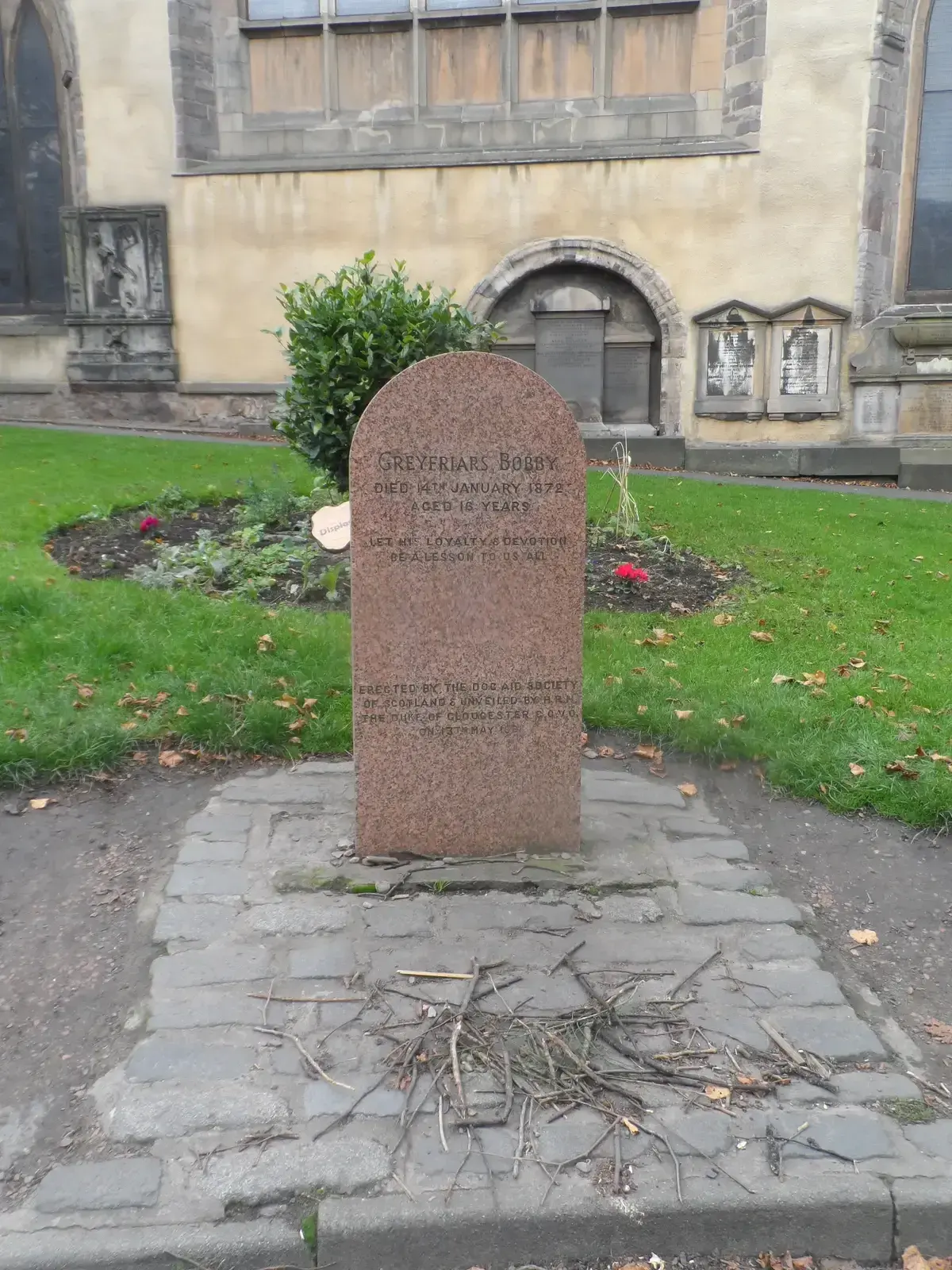
Bobby's headstone stands just inside the kirkyard gate near the kirk. Photo: Sheila1988, CC BY-SA 4.0, via Wikimedia Commons
Ghost Tours That Tell the Bobby Story
You do not need a tour to see the statue or the grave, both are free and open to the street and the yard. What a tour adds is a guide to walk you through the kirkyard's other stories and, on some routes, into the vaults afterwards. The table below lists the tours in this comparison whose route or description names Greyfriars or Bobby, with the price, length and meeting point exactly as the listings give them.
Comparing the Tours That Cover Greyfriars
Several tours in the set name Greyfriars Kirkyard or the Bobby legend on their route. The Edinburgh Haunted Underground Vaults and Graveyard Tour from Auld Reekie Tours is the only one of the four that explicitly names the Greyfriars Bobby legend among its stops, walking the kirkyard first and then descending into the South Bridge Vaults. The City of the Dead: The Double Dead Tour concentrates on the kirkyard's darker side, the Covenanter's Prison and the Mackenzie Poltergeist, with groups capped at 6.
The Edinburgh Evening Underground Ghost Tour routes through hidden wynds, Greyfriars Kirkyard and the Edinburgh Vaults. The Edinburgh Comedy Horror Ghost Bus Tour passes Greyfriars Kirk from the road on a 75-minute bus ride, so it sees the area but does not walk the graveyard. Prices run from $25 to $34.99 across the walking options, and every one of them offers free cancellation 24 hours ahead.
| Tour | Price | Length | Where it meets |
|---|---|---|---|
| Edinburgh Haunted Underground Vaults and Graveyard Tour | $34 | 1.5 hours | Pavement in front of 300 Lawnmarket, by the tourist information booth, police box and telephone box |
| City of the Dead: The Double Dead Tour | $34.99 | 1 hour 45 minutes | The tree on the pavement at the side of St Giles' Cathedral on the Royal Mile |
| Edinburgh Evening Underground Ghost Tour | $25 | 75 minutes | Police Box / Kiosk on the Royal Mile |
| Edinburgh Comedy Horror Ghost Bus Tour | $28 | 75 minutes | 7-9 George IV Bridge, outside the Edinburgh Central Library |
Which One Fits a Bobby Visit
If the Bobby story is your reason for coming to the kirkyard, the Edinburgh Haunted Underground Vaults and Graveyard Tour is the direct match, since its route names the Greyfriars Bobby legend alongside the Gothic mausoleums and notable burials, and it includes entry to the Edinburgh Vaults. It runs 1.5 hours for $34, is suggested for ages 12 and over, and is not suitable for wheelchair users. The Double Dead Tour at $34.99 is the deeper kirkyard option, reaching the locked Covenanter's Prison that ordinary visitors cannot enter, though it is built around the Mackenzie Poltergeist rather than the dog.
The Edinburgh Evening Underground Ghost Tour is the cheapest of the walking options at $25 and is not suitable for children under 7. The comedy horror Ghost Bus at $28 passes Greyfriars Kirk on its route through the Old Town and New Town, and while it is fun, it will not put you beside the grave. None of the listings state fixed start times, so the times show when you check availability. For a fuller comparison of every graveyard and vault option in the city, see the main guide to Edinburgh ghost tours.
Greyfriars Bobby Questions
What type of dog was Greyfriars Bobby?
The breed is usually given as a Skye Terrier, and the 1961 Disney film used a Skye Terrier on screen. But the point is disputed, and in 2022 Mike Macbeth argued a Dandie Dinmont Terrier is more likely. The full breed question is covered in was Greyfriars Bobby real.
Where is the original Greyfriars Bobby statue?
The bronze statue stands opposite the kirkyard gate at the junction of George IV Bridge and Candlemaker Row, on a drinking fountain paid for by Baroness Burdett-Coutts in 1873. The fountain is described as Edinburgh's smallest listed structure. How to see it and the grave is covered in the statue, the grave and the collar.
Who directed the Greyfriars Bobby movie?
The 1961 Walt Disney film was directed by John Cromwell and starred Donald Crisp. A later 2005 film, The Adventures of Greyfriars Bobby, starred James Cosmo and Christopher Lee. The films are listed in the pub and the films section.
Is the movie Greyfriars Bobby based on a true story?
It is based on the Edinburgh legend. A real dog called Bobby existed, and Lord Provost Sir William Chambers paid his dog licence in 1867, but historian Jan Bondeson has questioned the 14-year vigil and suggested Bobby was a stray fed by visitors. The evidence on both sides is set out in was Greyfriars Bobby real.
Where is Greyfriars Bobby's grave?
Bobby is said to be buried just inside the kirkyard gate near John Gray's grave. His headstone, erected by the Dog Aid Society and unveiled on 13 May 1981, reads Died 14 January 1872, Aged 16 years. John Gray's grave lies on the eastern path about 30 metres north of the entrance, as described in Bobby's headstone and John Gray's grave.
Which ghost tours include Greyfriars Bobby?
The Edinburgh Haunted Underground Vaults and Graveyard Tour names the Greyfriars Bobby legend on its route and costs $34 for 1.5 hours. The City of the Dead Double Dead Tour, the Evening Underground Ghost Tour and the comedy horror Ghost Bus also cover Greyfriars. Prices and meeting points are compared in ghost tours that tell the Bobby story.