 Ghost Tours Edinburgh Scotland
Deacon Brodie: The Cabinet Maker Who Led a Double Life
Deacon Brodie is Edinburgh's own Jekyll and Hyde, and the story is true. William Brodie was a respected cabinet-maker, locksmith and city councillor on the Royal Mile by day. From around 1768 he copied keys from wax impressions and robbed the city's wealthy homes by night. He was caught after a failed raid in Chessels Court, tried in August 1788 and hanged before a crowd of about 40,000 on 1 October 1788. This page tells his life, the trial and the legends around his death, then maps Deacon Brodie's Edinburgh today: Brodie's Close, Deacon Brodie's Tavern on the Lawnmarket and the tours that meet opposite it. The bookable tours are compared on Edinburgh ghost tours.
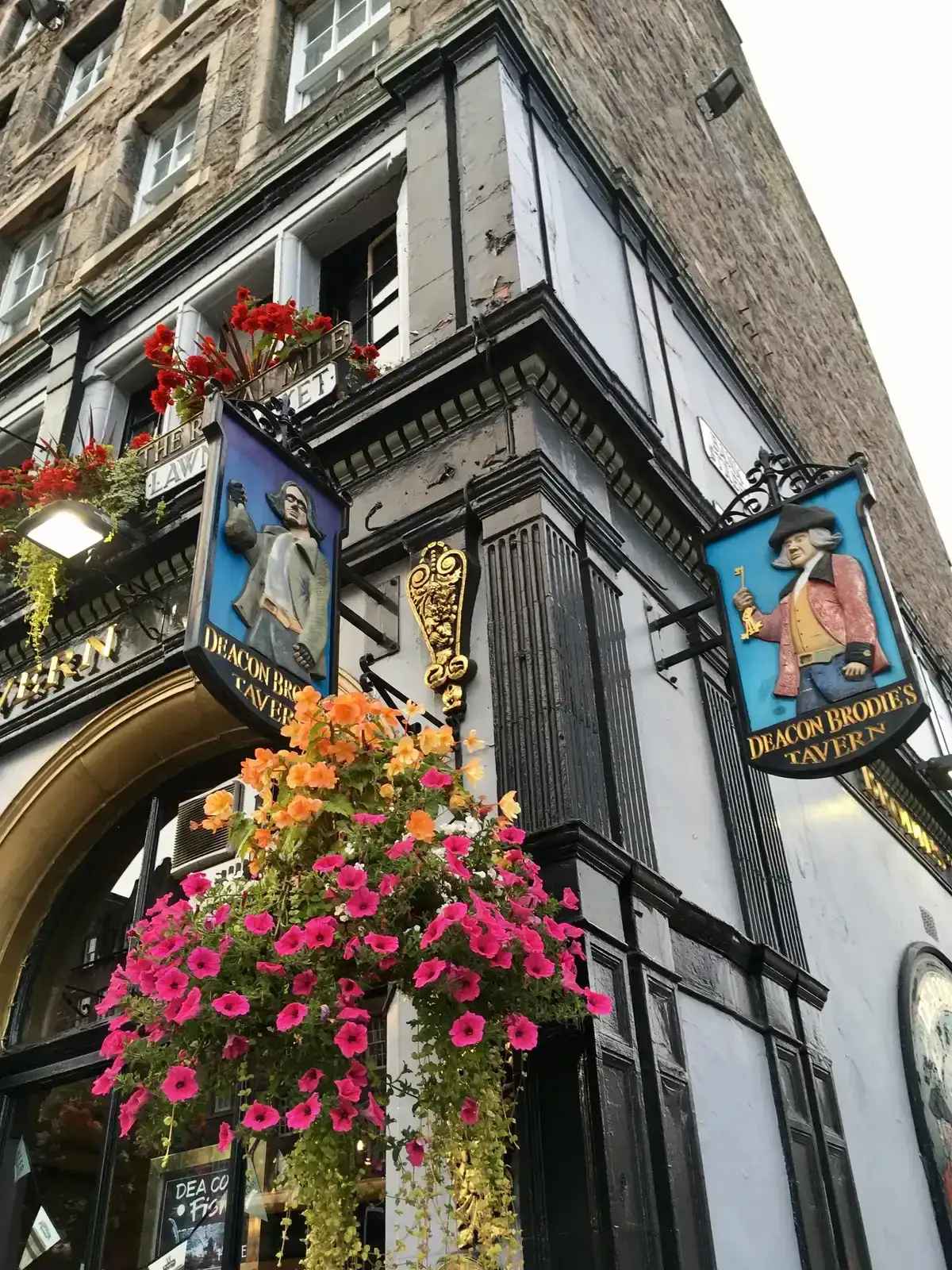
The tavern on the Lawnmarket is named for the cabinetmaker and burglar hanged in 1788. Photo: LornaMCampbell, CC BY-SA 4.0, via Wikimedia Commons
Quick answer Who Deacon Brodie was
Deacon Brodie was William Brodie, an Edinburgh cabinet-maker, locksmith and town councillor who lived from 1741 to 1788. By night he led a gang that burgled wealthy homes using keys copied from wax impressions. He was hanged on 1 October 1788 before a crowd of about 40,000. He inspired Robert Louis Stevenson's Strange Case of Dr Jekyll and Mr Hyde in 1886.
Key takeaways
- Read his full life story in Who Was Deacon Brodie and the raid, trial and hanging in The Raid, the Trial and the Gallows.
- See where he lived and drank in Deacon Brodie's Edinburgh Today, from Brodie's Close to Deacon Brodie's Tavern at 435 Lawnmarket.
- The Edinburgh Haunted Underground Vaults and Graveyard Tour meets opposite Deacon Brodie's Tavern for $34 and lasts 1.5 hours.
- Other Old Town villains such as Major Weir are covered on the page about haunted places in Edinburgh.
Who Was Deacon Brodie
William Brodie spent his whole life in Edinburgh, and most of it in public view. The table below sets out the key dates of his life and death, and the blocks that follow explain the two sides of the man.
The Timeline
This table pulls the documented dates of Brodie's life into one place. The early dates are his rise as a craftsman and councillor, and the 1788 dates cover the Chessels Court raid, his flight to the Continent, the trial and the hanging. The dates come from the biographical record of William Brodie.
| Year | What happened |
|---|---|
| 1741 | William Brodie is born on 28 September in Edinburgh |
| Around 1768 | He begins copying keys from wax impressions to burgle wealthy homes |
| Around 1781 | He becomes Deacon of the Incorporation of Wrights and sits on the town council |
| 1786 | He recruits John Brown, George Smith and Andrew Ainslie to his gang |
| 5 March 1788 | He leads an armed raid on an excise office in Chessels Court. The gang takes only 16 pounds |
| 9 March 1788 | He leaves Edinburgh for London, arriving on 12 March |
| 23 March 1788 | He sails on the Endeavour under the false name John Dixon |
| 1788 | King's Messenger George Williamson finds him in Amsterdam |
| 27 August 1788 | His trial begins. He and Smith are found guilty on the evidence of Brown and Ainslie |
| 1 October 1788 | He is hanged before a crowd of about 40,000 |
The Respectable Deacon
By day Brodie was exactly the kind of man Edinburgh trusted. Born on 28 September 1741, he was the son of Francis Brodie, Convenor of the Trades, and he worked as a cabinet-maker and a locksmith, which matters for the story, because a locksmith is the one man in the city who understands every lock he will later open. Around 1781 he became Deacon of the Incorporation of Wrights, the craft title that gave history its name for him, and he sat on the town council as well.
He moved in good company. He knew Robert Burns and the painter Henry Raeburn, and he belonged to the Edinburgh Cape Club. His family home and workshop stood in Brodie's Close on the Lawnmarket, on the same street as Deacon Brodie's Tavern, which trades today at 435 Lawnmarket. On the surface he was a man of trade and council.
Below the surface the money ran the other way. He funded gambling and mistresses with the proceeds of crime. The record notes two mistresses who did not know of each other and five children, and his gambling table was a tavern in Fleshmarket Close, an alley off the High Street. Respectability cost money, and burglary paid it.
The Burglaries
From around 1768 Brodie robbed the city's wealthy homes, and his method was the trade he wore in plain sight. He copied keys from wax impressions, so the locks opened as if the owners had let the gang in themselves. The method needed no forced entry.
In 1786 he assembled the gang that ended him: John Brown, George Smith and Andrew Ainslie. The gang's last job was the excise office in Chessels Court on 5 March 1788, the raid that broke the double life.
The tally of that raid is the best-known number in the story. An armed gang led by a town councillor and master locksmith got away with only 16 pounds. John Brown later turned informer and betrayed the others for a King's Pardon.
Sources: William Brodie, Wikipedia
The Raid, the Trial and the Gallows
The last seven months of Brodie's life ran from a bungled raid in Chessels Court to a scaffold in front of some 40,000 people. The documented record is clear on the dates. What happened on the scaffold itself is where the record ends and the legends begin.
Chessels Court, 5 March 1788
Chessels Court is a small court off the Canongate, and on 5 March 1788 Brodie led an armed raid on the excise office there. The gang got away with only 16 pounds.
After the raid Brodie left Edinburgh on 9 March 1788, four days after the raid, and reached London on 12 March. On 23 March he sailed on the Endeavour under the false name John Dixon, heading for the Continent and a life he would never get to live.
John Brown had already decided where his own survival lay. He turned informer for a King's Pardon, and his testimony put names, methods and dates in front of the authorities. King's Messenger George Williamson tracked Brodie to Amsterdam and brought the story back to Edinburgh. The man who had robbed the city for nearly two decades was caught not by a locksmith's failure but by his own accomplice.
The Trial and the Hanging
The trial began on 27 August 1788. Brodie and George Smith stood together, and the case against them rested on the evidence of Brown and Ainslie, the two gang members who had traded testimony for their own necks. Both men were found guilty.
He was hanged on 1 October 1788 before a crowd of about 40,000. The execution took place at the Old Tolbooth on the Royal Mile, the same prison that had held famous prisoners such as Agnes Sampson, Thomas Weir and Captain Porteous. Public hangings there took place from a rooftop platform from 1785, three years before Brodie's turn came.
The Heart of Midlothian mosaic on the High Street today marks the Tolbooth's old entrance. One legend places his burial in an unmarked grave at St Cuthbert's Chapel of Ease, but that rests on a single source and is unverified.
The Gallows Legends
Two stories cling to Brodie's execution and both are legends, not documented history. The first says he designed the gallows himself and became its first victim, a neat circle worthy of a playwright. The record is plain on this: the story is disputed. It is repeated here only as the story people tell, not as fact.
The second tale says he wore a steel collar and survived the drop. This is a legend, and nothing in the record supports it. Both legends survive because they fit the Jekyll and Hyde shape the story later took. A man who lived two lives deserves a death with a twist, so the story grew one.
This distinction matters when a guide tells the tale on the Royal Mile. The dates, the raid, the 16 pounds, the trial and the crowd are documented. The steel collar and the self-designed gallows are the folklore that grew around them. A good guide tells you which is which.
Sources: William Brodie, Wikipedia, Old Tolbooth, Edinburgh, Wikipedia
The Story of Edinburgh's Deacon Brodie: The Real Life Jekyll and Hyde
A Mercat Tours guide tells the Brodie story on the Royal Mile. Third-party video by Mercat Tours. This site did not shoot it and has no relationship with the creator.
Deacon Brodie's Edinburgh Today
You can walk Brodie's Edinburgh in an afternoon without buying a ticket. His close, his tavern and the Tolbooth's shadow on the High Street all sit on the Royal Mile, and two ghost tours meet directly opposite the tavern that carries his name.
Brodie's Close and Deacon Brodie's Tavern
Brodie's Close runs off the Lawnmarket and carries his name because his family home and workshop stood there. It is a free stop, a narrow close between tall tenement buildings of exactly the kind the Old Town built because the city walls left little space. The tavern is the louder landmark. Deacon Brodie's Tavern stands at 435 Lawnmarket, EH1 2NT, on the corner of the Lawnmarket and Bank Street, in a building that dates from 1806, eighteen years after his hanging.
The corner matters for tour planning. The meeting point for the Auld Reekie vaults and graveyard tour and the Terror Tour is the pavement in front of 300 Lawnmarket, next to the tourist information booth, police box and telephone box, which is the opposite side of the road from Deacon Brodie's Tavern. The vaults and graveyard tour costs $34, lasts 1.5 hours and takes in Greyfriars Kirkyard before entering the Edinburgh Vaults in the South Bridge arches. The Terror Tour costs $34, lasts 75 minutes, is strictly 18 and over, and includes a torture exhibition and the stone circle vault of The Watcher.
A word of honesty about both tours and this story: neither listing names Brodie as a stop, so book them for the vaults and the graveyards, and read this page for the man. What you get either way is the setting. The tour price buys the vaults, not the biography.
Jekyll and Hyde
Robert Louis Stevenson drew on Brodie for Strange Case of Dr Jekyll and Mr Hyde in 1886, nearly a century after the hanging. Before the novel Brodie had inspired Stevenson's play Deacon Brodie, or The Double Life. The respectable craftsman by day and criminal by night gave Stevenson the template for a doctor who becomes his own monster.
The story has kept reaching audiences since. Billy Connolly played Brodie in the 1997 BBC drama Screen One, and Muriel Spark's novel The Prime of Miss Jean Brodie is listed among the works that echo his name, though her Miss Brodie is a schoolteacher and shares only the surname.
If you want the history told aloud rather than read, two walking tours cover Edinburgh's darker past. The Edinburgh Dark History Tour costs $24.23, lasts 2 hours and covers murderers, thieves and hangings as history rather than a ghost story. The Darkside Ghost Tour costs $29, lasts 2 hours and climbs to Calton Hill, so it covers different ground from the Lawnmarket.
Where to Find Him: A Map of Brodie's Edinburgh
The table below gathers every Deacon Brodie location on this page into one list, with the address where the record gives one and what to look for at each stop. All of it is free to see except where a tour is named.
| Place | Address | What to see |
|---|---|---|
| Brodie's Close | Off the Lawnmarket, Royal Mile | The close where his family home and workshop stood, free to walk into |
| Deacon Brodie's Tavern | 435 Lawnmarket, EH1 2NT | The pub on the corner with Bank Street, in a building dating from 1806 |
| Tour meeting point | 300 Lawnmarket, EH1 2PH | The booth, police box and phone box where two tours meet, opposite the tavern |
| Heart of Midlothian | High Street, Royal Mile | The mosaic marking the Old Tolbooth entrance where Brodie was held and hanged |
| Chessels Court | Off the Canongate | The court where the 1788 excise office raid netted only 16 pounds |
| Fleshmarket Close | Off the High Street | The alley where he gambled at a tavern |
Sources: William Brodie, Wikipedia, Deacon Brodie's Tavern, VisitScotland, Auld Reekie Tours
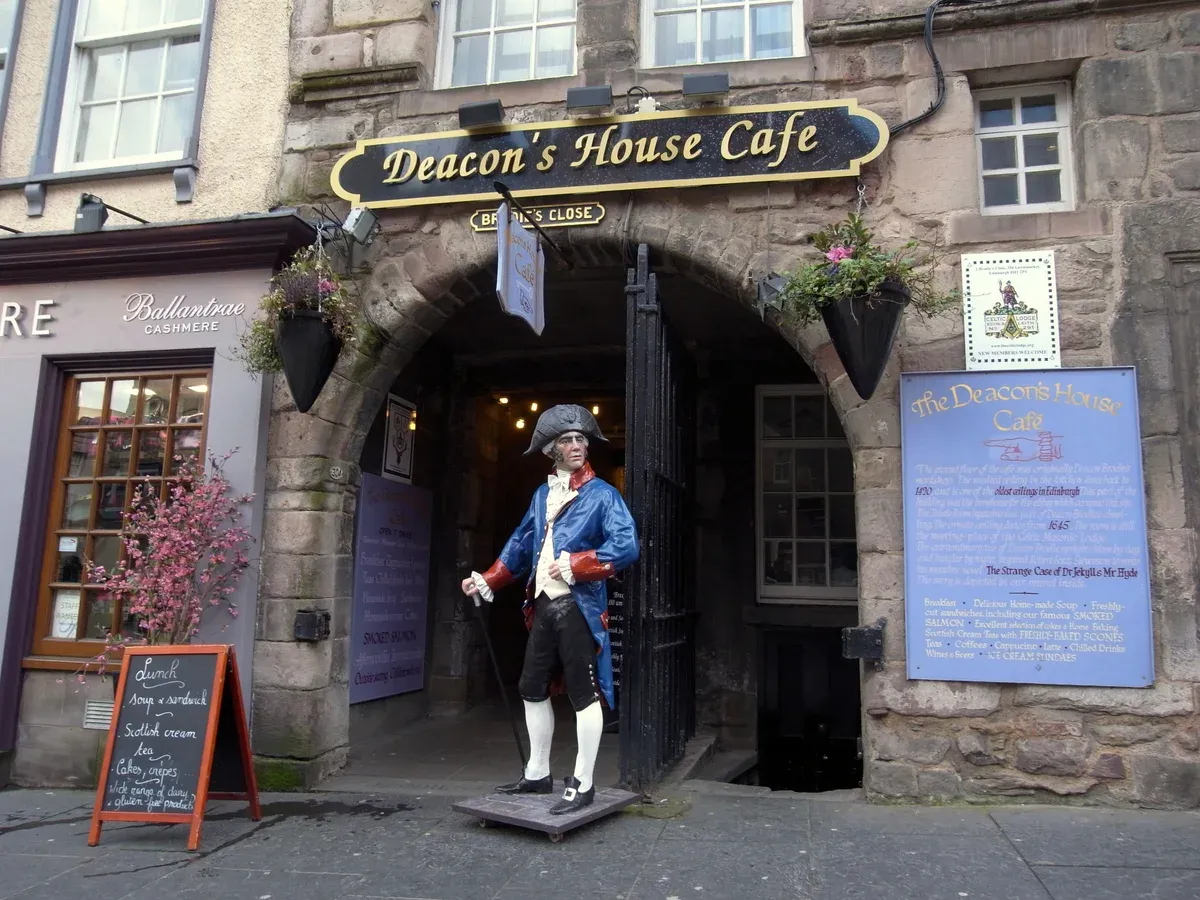
Brodie's Close was the home of the Brodie family on the Lawnmarket. Photo: Daniel Naczk, CC BY-SA 4.0, via Wikimedia Commons
The Old Tolbooth Where Brodie Waited
Brodie's last weeks were spent in the Old Tolbooth, the town jail that stood on the High Street beside St Giles' Cathedral. The building is gone, but its outline is still marked in the street.
The Jail on the High Street
The Old Tolbooth was built between 1386 and about 1400 and was pulled down in 1817. From 1785 public hangings took place on a platform on its roof, and the heads of executed prisoners were once shown on its north gable. Brodie was one of its best-known prisoners.
Others held there included Agnes Sampson, who was tried as a witch, Major Thomas Weir and Captain Porteous.
The Heart of Midlothian
A heart shape set into the setts outside St Giles' marks the old entrance of the Tolbooth. It is called the Heart of Midlothian, and people spit on it as they pass, a custom recorded on Wikipedia but not in an older source. Walter Scott took the Tolbooth door and key to his house at Abbotsford when the jail came down.
You can stand on the spot for free on the way to the Mercat Cross, where Mercat Tours meets.
The Friends Around Him
Before his arrest Brodie moved in the best company in the city. He knew the poet Robert Burns and the painter Henry Raeburn, and he belonged to the Edinburgh Cape Club. He sat on the town council and became Deacon of the Incorporation of Wrights around 1781 His father, Francis Brodie, had been Convenor of the Trades.
Away from that circle he gambled in a tavern in Fleshmarket Close and kept two mistresses who did not know of each other, with five children between them.
Deacon Brodie in Books, Plays and on Screen
The double life made Brodie a gift to writers, and the story has been retold for more than a century.
Stevenson and After
Robert Louis Stevenson wrote a play about him, Deacon Brodie, or The Double Life, and drew on Brodie for Strange Case of Dr Jekyll and Mr Hyde in 1886. Muriel Spark's novel The Prime of Miss Jean Brodie is listed among the works that echo his name. Billy Connolly played Brodie in a 1997 BBC Screen One drama.
The tavern that carries his name at 435 Lawnmarket dates from 1806, long after his death, and stands at the corner of the Lawnmarket and Bank Street.
The Escape That Failed
The record of his flight reads like a thriller. Brodie left Edinburgh on 9 March 1788, reached London on 12 March and sailed on the Endeavour on 23 March under the name John Dixon. The King's Messenger George Williamson tracked him to Amsterdam and brought him back.
His trial began on 27 August 1788, and he and George Smith were found guilty on the evidence of John Brown and Andrew Ainslie. Brown had turned on the gang for a King's Pardon.
Deacon Brodie FAQ
Who was Deacon Brodie and what did he do?
William Brodie, born on 28 September 1741 in Edinburgh, was a cabinet-maker, locksmith, Deacon of the Incorporation of Wrights and town councillor who burgled the city's wealthy homes from around 1768 using keys copied from wax impressions. Read the full story in Who Was Deacon Brodie.
Why is Deacon Brodie's Tavern famous?
Deacon Brodie's Tavern at 435 Lawnmarket, EH1 2NT is named for the man and stands opposite the meeting point of the Auld Reekie vaults and graveyard tour and the Terror Tour.
Who inspired Jekyll and Hyde?
Robert Louis Stevenson drew on Deacon Brodie for Strange Case of Dr Jekyll and Mr Hyde in 1886, and Brodie had already inspired Stevenson's play Deacon Brodie, or The Double Life. See Jekyll and Hyde for the full connection.
Who owns Deacon Brodie's Tavern?
The owner of Deacon Brodie's Tavern is not named in the records checked for this page. What the record gives is the building itself, which dates from 1806 and stands at the corner of the Lawnmarket and Bank Street, near Brodie's Close.
Did Deacon Brodie survive his own hanging?
No evidence supports that story. The tale that he wore a steel collar to survive the drop is stated as a legend, and the story that he designed the gallows and was its first victim is disputed. The documented fact is that he was hanged on 1 October 1788 before a crowd of about 40,000. Both legends are covered in The Gallows Legends.
Where can I see Deacon Brodie's Edinburgh?
Start at Brodie's Close and Deacon Brodie's Tavern on the Lawnmarket, then walk the High Street to the Heart of Midlothian, which marks the Old Tolbooth where he was imprisoned. The full list is in Deacon Brodie's Edinburgh Today, and the Terror Tour meets opposite the tavern for $34.