 Ghost Tours Edinburgh Scotland
Burke and Hare: The West Port Murders of Edinburgh
Burke and Hare killed 16 people in Edinburgh in 1827 and 1828 and sold the bodies to the anatomist Robert Knox. This guide follows the case from the body trade that made it possible to the trial that ended it. William Burke went to the gallows in front of a crowd said to number 25,000. His skeleton still stands in the city. You can see his death mask and a pocketbook said to be made from his skin at Surgeons' Hall, and the Old Town streets where it happened are all walkable today. Along the way you will find which Edinburgh ghost tours cover the story and which museums hold the evidence, so you can plan a visit around the facts rather than the folklore.
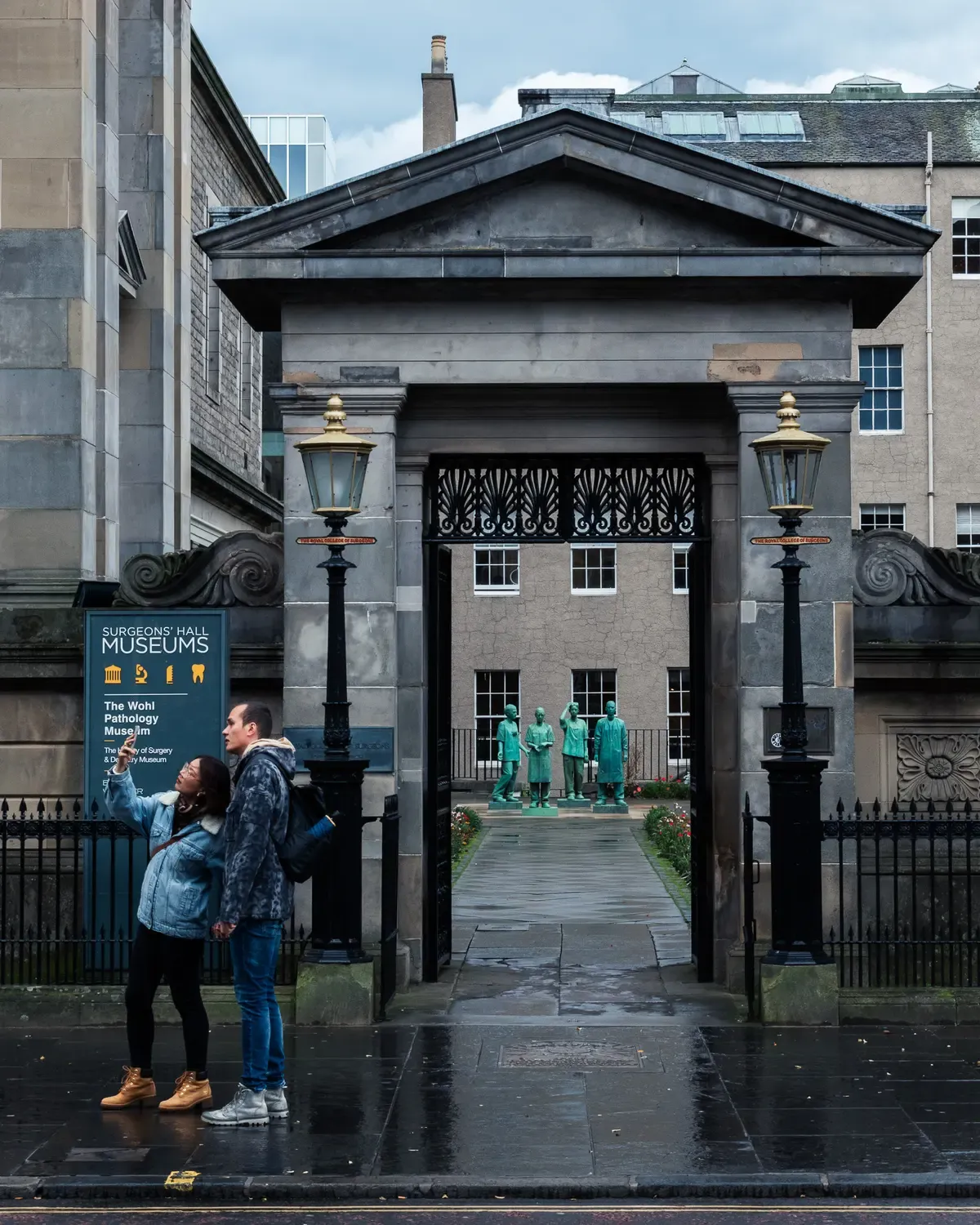
Surgeons' Hall on Nicolson Street is where the bodies Burke and Hare sold were dissected. Photo: JoeDerrySetch, CC BY-SA 4.0, via Wikimedia Commons
Quick answer The short version
Burke and Hare were two Irish labourers who murdered 16 people in Edinburgh in 1827 and 1828 and sold the bodies to anatomist Robert Knox for dissection. They worked from Tanner's Close in the West Port, smothering mostly poor lodgers. Hare turned king's evidence and walked free. Burke was hanged on 28 January 1829, dissected in public, and his skeleton is still shown at the University of Edinburgh's Anatomical Museum.
Key takeaways
- The murders ran across about ten months of 1827 and 1828, with Knox paying around 8 to 10 pounds per body.
- The Edinburgh Dark Secrets of the Old Town Ghost Walking Tour tells the Burke and Hare story on a 2 hour walk through Old Calton Cemetery and Canongate Kirkyard for $26.
- The legal side of the story starts with the resurrection men and the mortsafe cages still standing in Greyfriars Kirkyard, covered in the Greyfriars Kirkyard guide.
- The Old Town closes where the story unfolded are on the route of several ghost tours, and the Edinburgh Vaults have their own guide.
The Body Trade: Why Edinburgh Needed Corpses
The murders grew out of a shortage. Edinburgh's anatomy schools had more students than legal bodies, and the gap was filled by men who dug graves.
Where The Bodies Were Supposed To Come From
Under the 1752 Murder Act, the only bodies a dissection room could legally take were the bodies of executed murderers. Before the Anatomy Act of 1832, nothing else was lawful, and the punishment for murder in Britain included dissection, which made the anatomy table itself a scene of dread.
Robert Knox alone lectured to more than 400 students and his private anatomy school at Surgeons' Square counted 504 students in 1831. Every one of those students needed a corpse to cut.
The Resurrection Men
The shortage of legal bodies created demand for resurrection men, the grave robbers who dug up fresh burials and sold them on. Fresh mattered. A decayed body was useless to a dissector, so new graves were the targets and families kept watch.
Edinburgh knew this trade long before Burke and Hare. A kirk beadle at St Cuthbert's kirkyard was implicated in body thefts around 1742 and angry townspeople burned his house. St Cuthbert's had a high wall built by 1738 against snatchers, and a watchtower went up on the kirkyard boundary in 1827, the year before the murders began. In Glasgow, a watching society against the snatchers had 2,000 members.
Mortsafes And Watch-Houses
A mortsafe is an iron or iron and stone cage or slab that was padlocked over a coffin to stop snatchers reaching the body. Communities left one on a grave for about six weeks until the body was too decayed to be of use, then moved it to the next burial. Churches also built watch-houses to shelter the men who guarded graves overnight.
Two low iron cages stand in Greyfriars Kirkyard today as mortsafes, and you can walk up and look at them free of charge. Surviving mortsafes also exist at Cadder Parish Church near Glasgow. After the Anatomy Act of 1832 removed the market for stolen bodies, mortsafes were scrapped, and the ones left are all that remain of a brief and fearful period in Scottish burial custom.
What A Body Was Worth
The prices in the case show how the market worked. The first body sold to Knox, a lodger called Donald who died of dropsy at Hare's house on 29 November 1827, brought 7 pounds 10 shillings. Across the whole case, Knox is recorded as paying around 8 to 10 pounds per body.
The money was several pounds per body. The Anatomy Act of 1832 later ended the market by letting doctors dissect unclaimed bodies from hospitals, prisons and workhouses instead.
Sources: Anatomy Act 1832, Mortsafe
The Murders, Victim by Victim
Sixteen people died at Burke and Hare's hands across about ten months. The record names only some of them, and this table sets out what the sources actually show.
The Named Victims
The usual figure given for the Burke and Hare murders is 16 victims, killed over about ten months in 1827 and 1828. Most were poor lodgers, elderly women and marginalised people whose disappearances raised no alarm. The method was always the same: the victims were made drunk on whisky, then suffocated by one man covering the nose and mouth while the other lay across the body. The word burking, meaning to smother a victim, entered the language from this case.
The table lists the victims the record names, with the dates the sources give. James Wilson is dated to autumn 1828.
| Victim | When | What the record shows |
|---|---|---|
| Donald | 29 November 1827 | A lodger who died of dropsy at Hare's house, sold to Knox for 7 pounds 10 shillings as the first body |
| Abigail Simpson | 12 February 1828 | A named victim of the murder series |
| Mary Paterson | April 1828 | Her body was kept in whisky for about three months before dissection, and Knox's assistant William Fergusson recognised the corpse |
| Ann Dougal | not stated | A relative of Helen McDougal, among the victims |
| A grandmother and her mute grandson | June 1828 | Forced into a herring barrel for delivery to the anatomy rooms |
| James Wilson, known as Daft Jamie | Autumn 1828 | Killed aged about 18, he had a foot deformity, and a baker later reported Burke's nephew wearing his trousers |
| Margaret Docherty | 31 October 1828 | The last victim, found under straw by lodgers Ann and James Gray on 1 November 1828 |
Tanner's Close And The West Port
The murders took place in the West Port area of the Old Town, and Burke and Hare operated from Tanner's Close, the narrow court where Hare ran his lodging house with Logue and Margaret Laird, who later became Hare's wife. Burke, born in 1792 at Urney in County Tyrone, had served in the Donegal Militia and worked on the Union Canal before turning to cobbling and hawking in Edinburgh. From June 1828 he lodged two streets from Tanner's Close at his cousin John Broggan's house, which is where the last victim was found.
The bodies went out in tea-chests to Surgeons' Square, where Knox's assistant David Paterson was the contact at the dissecting rooms. Guides on the Edinburgh Dark Secrets of the Old Town Ghost Walking Tour put the streets back into the story on a walk that also covers the witch burnings.
Helen McDougal And Margaret Hare
Two women lived inside the conspiracy. Helen McDougal was Burke's partner, and Margaret Hare was the lodging house keeper who became Hare's wife. Both were named on the warrants issued on 3 November 1828 along with both men.
McDougal offered the Grays, the lodgers who found Docherty's body, 10 pounds a week to stay quiet, and they refused. At trial she received a not proven verdict, and an angry mob confronted her the day after the verdict, so she escaped through a back window of a police building. Margaret Hare was covered by the same immunity as her husband and was released on 19 January 1829, then attacked by a mob in Glasgow. The city's anger fell on everyone connected, and the Edinburgh rhyme of the time ran that Burke's the butcher, Hare's the thief, Knox the boy that buys the beef.
Sources: Burke and Hare murders, West Port murders
Selling Bodies For Dissection: The Killings Of Burke and Hare
How the anatomy trade worked and how the West Port murders were uncovered. Third-party video by History Hit. This site did not shoot it and has no relationship with the creator.
Trial, Hanging and Dissection
The case collapsed against half the gang and fell on one man. The legal deal that freed Hare still shapes how the story is told in Edinburgh today.
How the Murders Came to Light
Margaret Docherty was killed on 31 October 1828. On 1 November 1828, lodgers Ann and James Gray found her body under straw at Broggan's house, two streets from Tanner's Close. Helen McDougal offered the Grays 10 pounds a week to stay quiet and they refused. Police found Docherty's bloodstained clothes under a bed, and the police surgeon Alexander Black with Drs Robert Christison and William Newbigging examined the body. Warrants were issued on 3 November 1828 for Burke, Hare, McDougal and Margaret Hare.
The Lord Advocate, Sir William Rae, offered Hare immunity on 1 December 1828 if he turned king's evidence against Burke. Margaret Hare was covered by the same deal. On 4 December 1828 Burke and McDougal were formally charged with the murders of Mary Paterson, James Wilson and Margaret Docherty.
The Trial at Parliament House
The trial opened at 10am on 24 December 1828 at the High Court in Parliament House. Four judges sat: Lord Justice-Clerk David Boyle and Lords Meadowbank, Pitmilly and Mackenzie. About 300 constables kept order. Madame Tussaud sketched the proceedings. The prosecution called 55 witnesses, and Knox and his three assistants were not cross-examined. Burke's counsel was James Moncreiff. The judge split the indictment and Rae chose the Docherty case first.
The jury delivered its verdict on the morning of Christmas Day 1828. Burke was convicted. McDougal received a not proven verdict, and an angry mob confronted her the next day until she escaped through a back window of a police building. Hare walked free, and the crowd never forgave the arrangement. A rhyme ran: Burke's the butcher, Hare's the thief, Knox the boy that buys the beef. The word burking entered the language, meaning to smother a victim.
Burke's Hanging Before a Crowd of 25,000
Burke made a fuller confession on 3 January 1829. He was hanged on 28 January 1829 before a crowd estimated at 25,000. Window seats overlooking the execution were hired for between 5 shillings and 20 shillings.
Margaret Hare had been released on 19 January 1829 and was attacked by a mob in Glasgow. Hare himself was released on 5 February 1829 and left Edinburgh in disguise. He was recognised in Dumfries and escaped a crowd through a back window.
His later fate is unknown, and every story told about it afterwards is folklore.
The Public Dissection and Knox's Fate
The judge ordered that Burke's body be publicly dissected and his skeleton preserved. Professor Alexander Monro dissected him on 1 February 1829 in the Old College anatomy theatre. Students rioted to get in and police admitted them in batches of 50. Monro dipped a pen in Burke's blood and wrote that the words were written with the blood of Wm Burke. The sentence was deliberate: under the 1752 Murder Act, dissection was the punishment reserved for hanged murderers, and Burke ended on the anatomist's table just as his victims had.
Knox was never charged. He lectured to more than 400 students, and a Royal Society of Edinburgh committee later cleared him of dealing personally with the pair. Crowds burned his effigy all the same. The Royal College of Surgeons forced him to resign as museum curator by June 1831, he left Edinburgh in 1842, and the Royal Society of Edinburgh expelled him in 1847. He died on 20 December 1862 in Hackney.
Sources: Wikipedia, West Port murders, Wikipedia, Robert Knox)
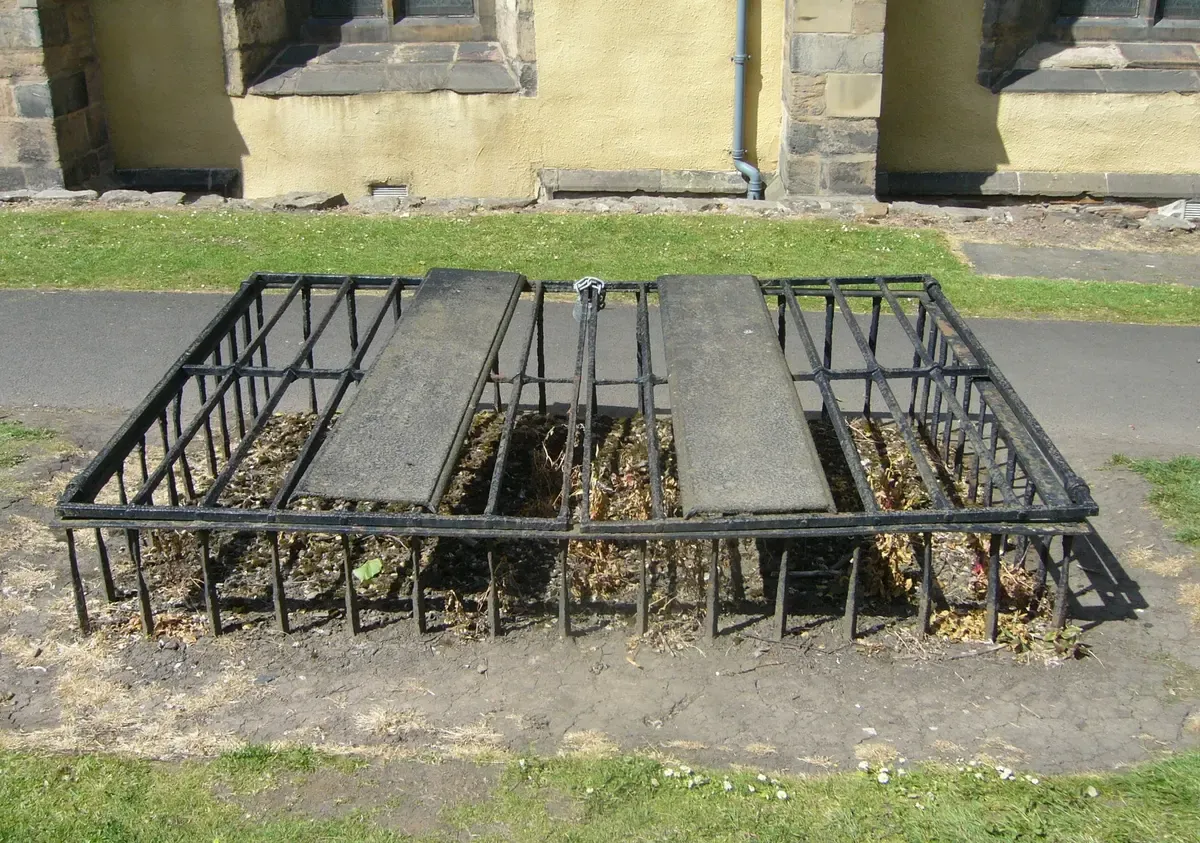
Mortsafes like this one were fitted over fresh graves to defeat resurrectionists. Photo: Kim Traynor, CC BY-SA 3.0, via Wikimedia Commons
Where to See Burke and Hare Today
Burke's body was never allowed a grave, and Edinburgh has kept the pieces on show ever since. Here is what survives and where it sits.
Burke's Skeleton at the Anatomical Museum
Burke's skeleton is displayed at the Anatomical Museum of the University of Edinburgh medical school, at Doorway 3, Medical School, Teviot Place, EH8 9AG. Entry is by advance booking only through Eventbrite, and the museum opens on selected Saturdays. Under 16s must be accompanied by an adult, and no photography or filming is allowed.
The museum is on the third floor, so visitors must be able to walk down the stairs in an evacuation. Admission price is not stated. Two low iron cages stand in Greyfriars Kirkyard as mortsafes, the iron devices that were padlocked over coffins for about six weeks until a body was too decayed to be of use to the resurrection men, then reused.
The Death Mask and the Pocketbook at Surgeons' Hall
Surgeons' Hall holds William Burke's death mask and a pocketbook said to be made from his skin. The museums are on Nicolson Street, EH8 9DW, open 7 days a week from 10am to 5pm with last entry at 4:30pm. Adult admission is £10, concessions £6.50 and children 5 to 15 £5.50. Children under 5 are free. The museum recommends a minimum age of 10, and children under 16 need an adult. Tickets are bought at the Level 3 reception with no pre-booking for standard visits. The museum warns that it contains human remains, which some visitors may find distressing.
The building itself fits the story. The present Surgeons' Hall was designed by William Henry Playfair and finished in 1832, the year the Anatomy Act closed the body trade that had fed Knox's rooms. The Royal College of Surgeons of Edinburgh was founded in 1505 and its museum collection was announced in 1699.
The West Port and Tanner's Close
The murders took place in the West Port area of the Old Town, and Burke and Hare operated from Tanner's Close. Burke was an Irish labourer born in 1792 at Urney in County Tyrone who became a cobbler and hawker in Edinburgh. Hare ran a lodging house in Tanner's Close.
The Anatomy Act 1832
The shortage of legal bodies for anatomy teaching had created the demand for resurrection men who dug up fresh graves. Before 1832 only the bodies of executed murderers could legally be dissected, under the 1752 Murder Act. A parliamentary select committee had drafted an anatomy bill in 1828, before the murders came to light, and the House of Lords rejected it in 1829.
The West Port murders and the 1831 London Burkers case pushed Parliament to act. The Anatomy Act was passed on 1 August 1832 and let doctors dissect unclaimed bodies from hospitals, prisons and workhouses, with workhouse bodies unclaimed after 48 hours eligible. After 1832 mortsafes were scrapped, though some survive in Scottish churchyards, including the pair at Greyfriars.
Sources: Surgeons' Hall Museums, University of Edinburgh Anatomical Museum, Wikipedia, Anatomy Act 1832
Ghost Tours That Tell the Burke and Hare Story
Three bookable tours in this comparison name the West Port murders on their route or in their description. The figures below come from the booking platform listings, and the Edinburgh Dungeon also stages the story as a live-actor show.
Tours That Cover the West Port Murders
The table compares the tours whose route or description names Burke and Hare, with the price, length and ground covered as each listing gives them.
Not every dark tour tells this story. The Edinburgh Dark History Tour covers murderers and hangings as general topics without naming the pair in its listing. The Edinburgh Dungeon stages Burke and Hare as a scripted scene inside its 70 to 75 minute walk-through show, which is the version to choose if you want theatre rather than a walk. Greyfriars Kirkyard and the underground vaults are covered on their own pages at Greyfriars Kirkyard and Edinburgh Vaults.
The tours listed here show no start times in their listings. Starting times appear when you check availability.
Burke and Hare Tours Compared
Prices are per person in US dollars as the platforms list them, with duration and route from the same listings.
| Tour | Price | Length | Where it goes |
|---|---|---|---|
| Edinburgh Haunted Underground Vaults and Graveyard Tour | $34 | 1.5 hours | Greyfriars Kirkyard then the Edinburgh Vaults, with the Burke and Hare stories on the way |
| Edinburgh Comedy Horror Ghost Bus Tour | $28 | 75 minutes | Old Town and New Town by vintage double-decker, with the Burke and Hare tales told by the conductor |
| Edinburgh Dark Secrets of the Old Town Ghost Walking Tour | $26 | 2 hours | Old Town alleys, Old Calton Cemetery and Canongate Kirkyard, with stories of Burke and Hare and the witch trials |
Sources: Burke and Hare murders on Wikipedia, Surgeons' Hall Museums
Burke and Hare Questions
Is the movie Burke and Hare based on a true story?
Yes. The 2010 film Burke and Hare is one of several screen versions of the real West Port murders, in which two men killed 16 people in about ten months and sold the bodies to anatomist Robert Knox. The documented case is laid out on this page.
What is the nursery rhyme about Burke and Hare?
An Edinburgh rhyme runs: Burke's the butcher, Hare's the thief, Knox the boy that buys the beef. It fixes the blame on all three, since Knox bought the bodies without ever being charged. The Edinburgh Dark Secrets of the Old Town Ghost Walking Tour covers Burke and Hare on its route.
Is there a movie about William Burke and William Hare?
There are several. The Flesh and the Fiends from 1960 and Burke and Hare from 2010 are the best known, Dylan Thomas wrote The Doctor and the Devils about the case, and Robert Louis Stevenson's short story The Body Snatcher of 1884 draws on it too. The history behind them starts in Tanner's Close and the West Port.
Is Burke and Hare on Netflix?
Streaming availability changes often, so check your own Netflix region. If you would rather hear the story told live, the Edinburgh Comedy Horror Ghost Bus Tour includes the Burke and Hare tales.
Where is Burke's skeleton today?
Burke's skeleton is displayed at the Anatomical Museum of the University of Edinburgh medical school on Teviot Place. It opens on selected Saturdays only, by advance booking through Eventbrite, and no photography is allowed. His death mask and the pocketbook said to be made from his skin are at Surgeons' Hall Museums nearby on Nicolson Street.
Why did Hare escape punishment?
Hare received immunity for turning king's evidence against Burke, a deal offered by the Lord Advocate on 1 December 1828. Burke alone was convicted and hanged on 28 January 1829 before a crowd of about 25,000. The Edinburgh Haunted Underground Vaults and Graveyard Tour lists the Burke and Hare stories on its route.